

In Brief
In addition to the existing fire prevention, protective measures, and fire safety management procedures you (should) have in place, your Fire Risk Assessments (FRA’s) for ‘Multi-Occupied Premises’* will need to be reviewed (regardless of building height), and these FRA’s should now include, if they don’t already, the following considerations:
- External fabric of building, construction materials and cladding, windows or openings, and balconies, in order to minimise the risk of fire spread on the external envelope of the building, and
- The type and condition of flat entrance doors (between dwellings and common parts) will also need to be assessed.
You also need to provide suitable information and instruction to all residents, with regards to:
- The importance of fire doors in the premises and how to ensure their condition/use is maintained.
- In line with the evacuation strategy, what action to take in the event of fire (e.g. how to raise the alarm, what to do if hearing the alarm, and evacuation protocols, escape route/exits etc.).
Where the building is more than 11m in height, all of the above, plus:
- Carry out fire door inspections quarterly in common areas, and annually for flat entrance doors.
Where the building is more than 18m or 7 storeys in height, all of the above, plus:
- Building plan and floor plans, and detail of external wall construction materials to be provided to the fire service.
- Secure premises information box to be installed, making the above information available on site for the fire services, as well as key contact information.
- You need to provide wayfinding signage on all floors, accounting for fire conditions (i.e. signs are visible in smoky conditions and clearly identify flat and floor numbers).
- Additional monthly checks to be implemented on firefighting equipment or systems (e.g. firefighting or evacuation lifts, fire detection/alarm systems etc.).
- You also have to notify the fire service if fire safety systems/equipment are non-operational for more than 24hrs.
In addition to the above, there are also a significant number of additional requirements for those defined as ‘Higher Risk Buildings’ – residential buildings over 18 metres or 7 storeys with two or more dwellings, which may also include hospitals and care homes, hospices, or even student residences (where they meet this height threshold). These are elaborated upon in ‘The Long Read’, below.
* Multi-occupied premises are those that are not solely domestic premises (e.g. private dwelling house) and which contain two or more separate residential units, with shared common areas or facilities.
The Long Read
Following enactment of the Fire Safety Act 2021 last year, and both the Building Safety Act 2022 and the Fire Safety (England) Regulations 2022 being introduced, with various new requirements coming into force over a period of 12-18 months – the landscape for fire safety legislation and fire risk assessment is changing, undoubtedly for the better, but what does this mean for you?
Unsurprisingly, being borne out of the inquiry following the tragedy at Grenfell Tower in 2017, a lot of the changes relate to high-rise residential buildings, as well as the approval and use of certain building products, including the design, construction and management of new buildings – if this doesn’t sound like it applies to you don’t stop reading yet, there is far more to it than that!
The Fire Safety Act 2021
This new legislation serves to clarify the Regulatory Reform (Fire Safety) Order 2005 – the primary piece of legislation governing fire risk assessment (FRA) in non-domestic premises – to extend the requirement for FRA’s to specifically include consideration of the building structure itself, external walls, cladding, balconies, windows and openings, and (inside the premises) flat entrance doors between domestic parts and common areas in ‘multi-occupied’ buildings.
These elements must now be considered in your fire risk assessments – if they aren’t detailed, you will need to arrange an FRA review
External Wall Assessment
In terms of external walls, you will likely have received a Government questionnaire in late-2022 requesting confirmation that any of your residential buildings with external ACM (Aluminium Composite Material) or HPL (High Pressure Laminate) cladding have had, or are scheduled for, a Fire Risk Appraisal of External Walls (FRAEW), in line with the PAS9980 standard. Alternatively, you may have provided confirmation that no such building products are present and no FRAEW surveys are therefore required.
These appraisals are not likely to be something your fire risk assessor can complete, though they should be able to advise on whether one is needed. For relevant buildings, your assessor will need the FRAEW report to be able to do their job properly, and fire risk assessments aren’t likely to be deemed ‘suitable and sufficient’ without this additional survey in place to inform them.
One serious concern with these changing demands is the lack of competent fire risk assessors to undertake this work that is now required.
Multi-Occupied Buildings?
Reversing slightly, it is important to note that these requirements are applicable to ‘multi-occupied premises’ so, it is important to consider what we mean by this phrase. Effectively these are not single domestic premises, as in the case of a private dwelling house, and they need to contain two or more separate residential units with shared common areas or facilities. This can include small blocks of flats, high-rise residential buildings like Grenfell Tower, or smaller low-rise buildings such as a boarding house with private-side (staff) accommodation or an office or care home building with private residential apartments or staff accommodation incorporated into the building.
The ‘Responsible Person’ (normally the owner/manager of these buildings) must arrange for an update of FRA’s to ensure they include these ‘new’ areas of consideration, and to ensure that appropriate measures are in place to manage the risks associated with them.
When do you need to review your FRA?
In a helpful move, the new Fire Risk Assessment Prioritisation Tool can assist in establishing the urgency with which you need to act.
Most ‘standard’ buildings (if there is such a thing), where fire safety is being well managed – a category into which you hopefully fall – are likely to fall into Tier 5 and as such you may well be fine to just consider these issues as and when your Fire Risk Assessments are next due for review.
Worked Examples – Fire Risk Assessment Prioritisation Tool:
| Example 1 – School Boarding House | Example 2 – Residential Care Home |
|
|
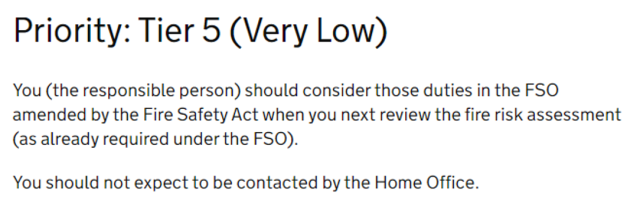
* ‘FSO’ in the text copied from the GOV.UK website above refers to ‘Fire Safety Order’, specifically The Regulatory Reform (Fire Safety) Order 2005.
The Fire Safety (England) Regulations 2022
In force since January 2023, these regulations also aim for improvement of fire safety in high-rise and other multi-occupied residential buildings, and set out new responsibilities for ‘Responsible Persons’ (RP’s) – i.e. those people in control of the premises and responsible for fire safety, such as the owner, landlord, managing agent, employer.
Potential penalties include unlimited fines and/or imprisonment for senior individuals in an organisation
The Fire Safety Act and these associated regulations also give fire authorities a clearer remit for taking enforcement action if RP’s are found to breach Regulations, and with the escalation in penalties for safety offences in recent years, this is worth getting right!
In terms of the requirements of the Fire Safety (England) Regulations 2022, these are largely set out ‘In Brief’ at the start of this article, although they stop short of outlining the following additional requirements for residential buildings over 18m or 7 storeys, classed as ‘Higher Risk Buildings’:
- Registration with the Building Safety Regulator (BSR) – a new part of the Health and Safety Executive (HSE), and appointment of a Building Safety Manager (in line with Building Safety Act 2022).
- Preparation of a Building Safety Case (in line with Building Safety Act 2022), and application for a Building Assessment Certificate – issued by the BSR when they are satisfied with the fire safety measures and controls in place).
- Maintain building information throughout the lifecycle of the building (design, construction, and occupation) as part of the ‘Golden Thread’, to ensure people have the requisite information available to allow building safety to be managed throughout its life.
- Prepare an engagement strategy for residents, promoting participation and involvement in building safety decisions.
It should also be noted that supporting documentation relevant to the construction and fire risk assessment of buildings have either been updated, or are in the process of review, including the Building Regs guidance, Approved Document B, and the Fire Safety Risk Assessment guidance produced by the Government.
The Building Safety Act 2022
The Building Safety Act is being enacted in stages across a period of around 18 months (next major sections are being introduced in October 2023).
The Act is designed to protect leaseholders in the event remediation is required, such as the removal/replacement of combustible cladding (with which we are all now familiar). It also aims to ensure that residents of high-rise blocks have more of a say and can raise issues direct with the owner or manager of buildings (so called ‘Accountable Persons’) – if they feel like they are being ignored, they can then escalate these issues directly with a new regulatory body ‘The Building Safety Regulator’, part of the HSE.
This should ensure, in future, that there is more accountability when residents raise valid concerns – they cannot and should not be ignored
It also serves to improve clarity over duties in the planning, design and construction process, for parties including the Principal Designer or Principal Contractor, and the Accountable Persons mentioned above (building owners/managers) to ensure safety risks are effectively managed.
Combustible cladding materials will also be banned, and sprinklers will become mandatory in new residential buildings over 11 metres (the height limit of traditional firefighting measures) – this height limit remains at 18m+ for non-residential buildings, though.
There are obviously huge impacts on the construction industry following the introduction of the Building Safety Act, and important consideration will need to be made for new building projects and for those that are currently in the planning and design process.
The important section around a strategy for engagement with residents of buildings also aligns with the requirements of the new Fire Safety (England) Regulations 2022 and is a suitable approach to adopt regardless of the type or size of building – dare I say, engaging with and informing residents in a building should be a ‘common sense’ step to take when it comes to fire safety?!
The Future
Whilst this is by no means the end of the road, we will work to keep you updated on further developments as they happen – subscribe to our newsletter (in the footer below) to ensure you don’t miss out on these updates.
Cumulatively, this new legislation represents a real step change for fire safety in residential premises, which, when implemented (and enforced) to their fullest extent, will hopefully help to prevent future tragedies and ensure the safety of residents. Everyone has a right to feel safe in their homes and this will hopefully go a long way towards ensuring that in the future, they can.
If you have further questions or need to arrange for a review of your fire risk assessments, please contact us.

