


Consultation is ongoing between key stakeholders and the Department for Levelling Up, Housing and Communities (DLUHC) on the requirement to fit sprinklers in care homes. Whilst this will already be mandatory for all new care homes over 11m in height, owing to the Building Safety Act 2022, there appears to be an intention to apply this to all new care homes.
Should it proceed in England, this would fall into line with decisions in Scotland and Wales, which already extend the requirement for sprinklers to care homes and new (and major refurbishments of existing) school buildings.
Sprinklers in all schools would undoubtedly be a positive risk feature and reduce the risk of fire spread significantly, by extinguishing or containing a fire in the early stages. The likelihood for widespread damage or loss of entire buildings would also be massively reduced, ensuring continuity of education provision in the event of a fire – but other than a requirement to risk assess new school buildings to establish a case for sprinklers, there is currently no intention to make them a legal requirement.
The case for sprinklers in schools has a powerful lobby too, in the form of the insurance companies that underwrite these buildings and who have £billions’ at risk. Zurich Municipal for one warns that:
‘…inconsistent fire safety standards are putting children’s lives and education at risk’!
In the same article (February 2023), Zurich also highlight that there were 219 school buildings damaged by fire last year, with 181 fires in care homes – so why are the Government not acting, when it seems to be such a compelling argument?!
The numbers behind those statistics…
First, the number of fires listed above is not quite as comparable as the ‘near-200’ figures appear to suggest. If you take the figures* as read, with 24,454 schools in England serving 9 million pupils, and only 14,535 care homes with around 400,000 residents – the prevalence of fires in care homes appears to be nearly 40% higher!
(* it is unclear whether the article relates to England or the UK).
The statistics produced by the Government for the number of primary fires, casualties and fatalities in both educational premises and care homes (note: both data sets reflect England) also paint a starkly different picture between these two sectors:
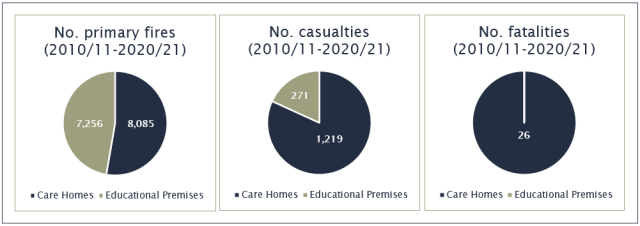
With 8,000 fires in care vs. nearer 7,000 in education, across the decade, the prevalence of fires is clearly significantly higher in care homes – Care Homes also have 4.5 times the number of casualties and 26 people lost their lives, compared to none in the educational premises.
Targeting care homes first certainly does seem to be the logical choice when it comes to life protection and the safety of the individuals at risk. When it comes to fire risk assessment, a legal requirement for all schools and care homes, understandably the primary focus is also protection of life. Far lower priority is placed on continuity of service and property protection, for better or worse, and whilst there is an argument that loss of, or disruption to, service in a care home is itself a risk to life, the same is simply not true in a school setting.
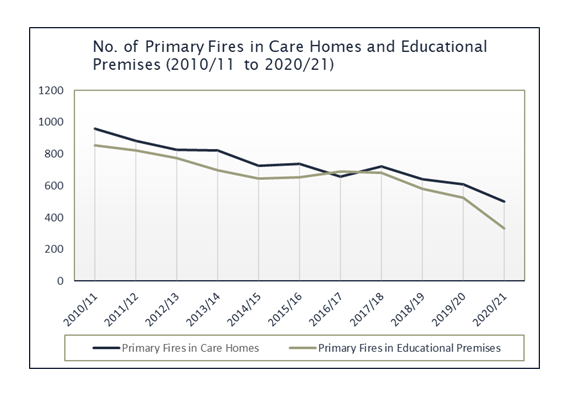
On a final note, there is a small glimmer of hope in this tragic set of data, as across this period there is a reducing number of fires on both sides, which can only be a good thing. The casualty and fatality numbers do not follow this trend so closely, but the reduction in the number of incidents does hopefully indicate improving fire prevention measures across the board.
In summary
Sprinklers in care homes, especially with a population who may not be able to evacuate the premises unaided, or where overnight staffing levels are not sufficient to ensure the safety of all residents, should absolutely be a mandatory requirement in our view. It is potentially the difference in making the 26 in the graph above a 0!
Now… who pays for such a programme of retroactively fitting these systems across the care sector is a whole other article in itself (for another day perhaps), but with squeezed budgets in care it is not likely to be a voluntary move any time soon.
We finish with some questions on the school front, though:
- Is the fitting of sprinklers in school buildings a good idea? – Yes.
- Would sprinklers in schools reduce disruption to education in the event of fire? – Absolutely.
- Would sprinklers in schools significantly reduce the loss of, or damage to, buildings? – Undoubtedly.
- Would sprinklers in schools reduce the significant cost of claims faced by insurance companies? – Again, it’s a yes, could even have a positive effect in reducing premium costs.
- Is the failure to mandate sprinklers in schools ‘putting children’s lives at risk’? – It appears this statement is not supported by the facts (but I do still struggle to write the word ‘No’).
We will certainly be revisiting this topic in the coming months, especially with the DLUHC consultation in progress, but in the meantime our advice would be to seriously consider the cost-benefit case for including sprinklers if you are building or refurbishing premises. It may even be worth a conversation with your insurers or brokers – whilst they are unlikely to foot the entire bill, it is in their interests for you to install such risk reduction measures and they may well be able to offer risk management bursaries to make the case for sprinklers even more compelling.
If you have found this article useful or wish to discuss your own fire safety risk assessments, please don’t hesitate to contact us:
Adam Webb (Director – Pearson Webb Consulting Ltd)
07739350638 | adam@pearsonwebb.co.uk

