


What Are the Common Issues?
During our Health & Safety Audits, we regularly identify issues with boarding house risk assessments, such as:
- No boarding house risk assessments in place (yes really!).
- Risk assessments across the various boarding houses are identical – even though every boarding house is likely to have its own quirks!
- Safety concerns identified during our site tour that have not been addressed in the risk assessment, such as areas of low headroom, bedroom furniture presenting a toppling risk etc.
- Foreseeable hazards associated with pupils (e.g. lack of risk perception, lack of physical/emotional maturity, likelihood of horseplay etc.) have not been addressed in the risk assessments.
- The school has lots of great control measures in place which are not detailed in the risk assessment.
- House staff being expected to complete risk assessments for their boarding houses but have not received any training in risk assessment methodology or common hazards that they would expected to identify and assess.
- House staff not being aware of the content of the risk assessments for the boarding houses that they work in.
- House staff not being actively involved in the risk assessment process, and so have not had the opportunity to provide any input or feedback.
What’s the Solution?
Here at Pearson Webb, we don’t just talk about problems and leave you hanging – we provide our clients with solutions! We’ve created a 1-day Keeping Boarders Safe training course covering risk assessment law and methodology, with case studies and examples specific to a boarding setting and reference to the National Minimum Standards for Boarding Schools. We’ll also tailor the course to use your school’s own risk assessment procedures and template forms and can include site-specific case studies and examples.
The training day with Pearson Webb Consulting was excellent. They managed to make a potentially dry and difficult subject very engaging and relevant to our Housemasters and Housemistresses…
… Their knowledge and expertise was very applicable to our House staff and our boarding houses. They have produced template risk assessments which incorporate all of the relevant legislation and the updated National Minimum Standards, and they are following this up with visits to complete the risk assessments for each of our boarding houses, so it is not just a stand-alone day but part of a thorough process. They understood our context and they were able to give very practical and helpful guidance. I would thoroughly recommend this process to fellow Deputy Heads.”
Lewis Faulkner – Deputy Head Pastoral, Malvern College
The course will give your boarding/house staff the confidence and competence to compile suitable and sufficient risk assessments for their boarding houses and will also serve as an opportunity for them to come together as a group and discuss any Health & Safety concerns, with the trainer providing advice on potential solutions.
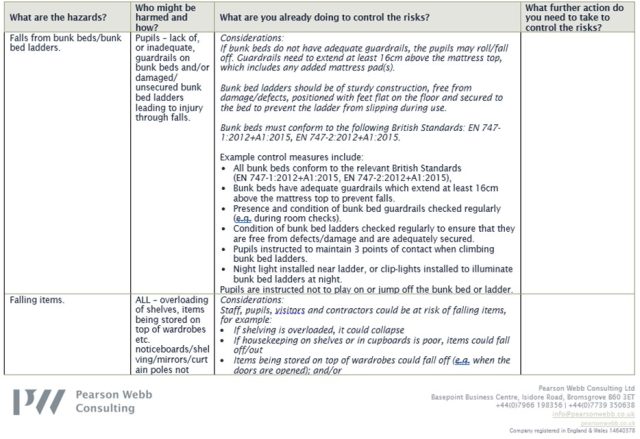
In addition, we’ve created a detailed (62-page!) template risk assessment for boarding houses packed with guidance and example control measures to help you manage the risk appropriately. Your House staff will need to make sure that it’s tailored to their environment, equipment, and pupils – but I’m sure you’ll agree it’s a great starting point!
To find out more, you can download the course outline below:
If you have any questions or would like to book, or would like to find out more about our Health & Safety advisory and audit services, please contact us.
If you found this article useful and don’t want to miss out on our future news, then you can sign-up to receive our newsletter, in the footer below.

